Why Is STEM Education Important for Kids?
"STEM is important for kids." You've probably heard this so many times it's stopped registering as an actual claim and turned into background noise, the kind of thing schools put on a banner without anyone quite explaining why. So let's actually unpack it. What's really behind that sentence, and is it true for reasons beyond "good jobs later"?
Short answer: yes, though the job numbers alone are worth pausing on before we get to the more interesting reasons.
The numbers, briefly
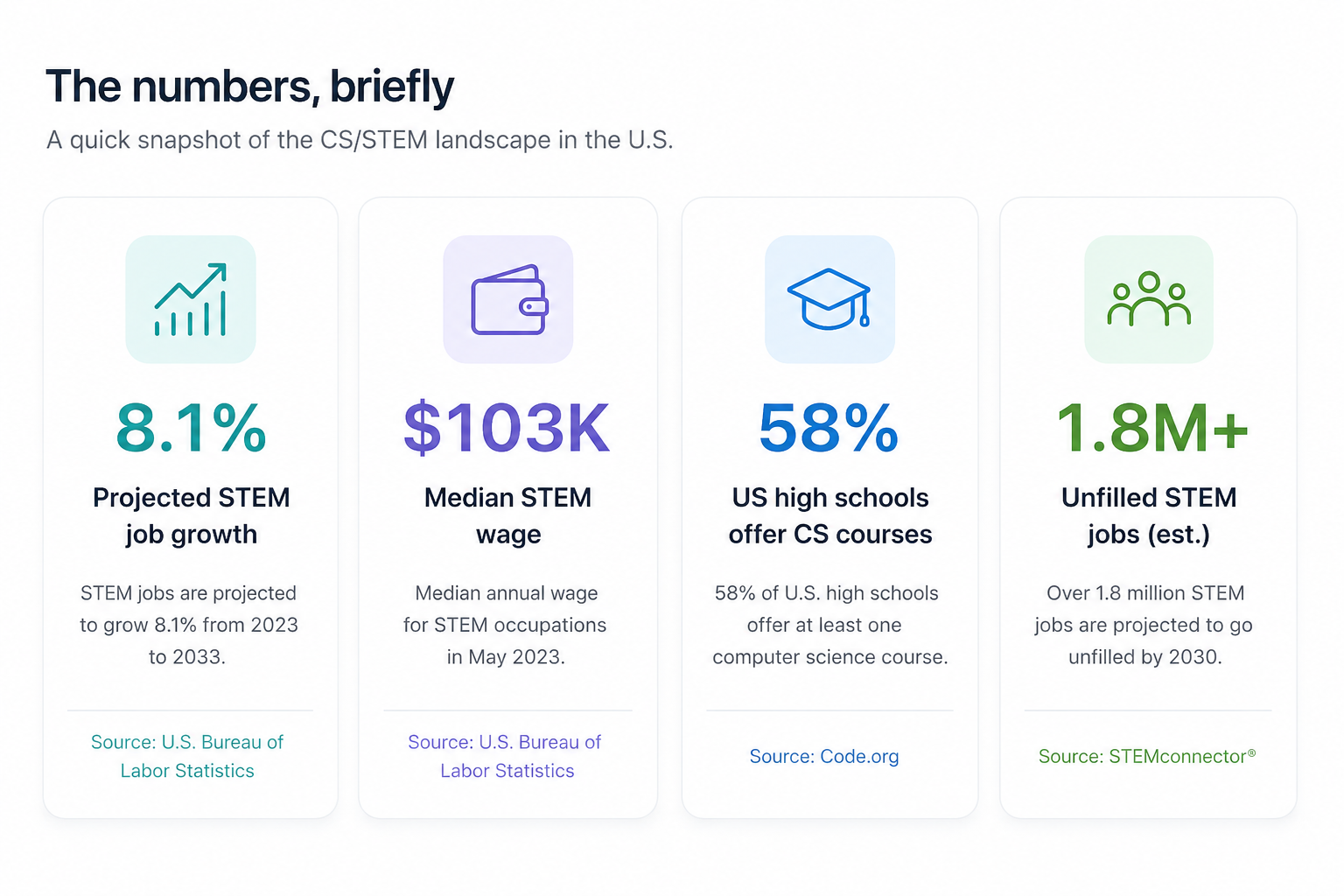
STEM occupations are projected to grow 8.1% between 2024 and 2034, roughly double the 4% growth rate for jobs overall, adding something like 850,000 new positions in the US alone. The pay gap is real too. Median STEM wages sit around $103,000 a year, more than double the median for non-STEM work. Fields like data science and cybersecurity are growing even faster than the STEM average.
Here's the part that doesn't get said enough, though: only about 58% of US high schools currently offer computer science courses. So the demand for these skills is climbing fast, and the schools tasked with building them aren't uniformly equipped to do it. That gap is exactly where a lot of the anxiety around "is my kid going to be ready" actually comes from, and it's not unfounded.
But the job market isn't really the interesting part
Here's the thing about leading with career stats: they make STEM sound like something you endure now for a payoff decades away, which is a pretty joyless way to think about a 7-year-old's Tuesday afternoon. The more honest case for STEM has almost nothing to do with future employment and everything to do with how kids think, right now.
STEM subjects, done well, teach a kid to sit with a problem that doesn't have an obvious answer. Not a worksheet with one correct box to fill in, but a real question: why did this bridge design collapse in the simulation, why won't this code run, why did the plant in the science experiment die when the other one didn't. That's a genuinely different mental muscle than most of the school day exercises, and it's one that transfers to basically everything else a kid will ever do.
There's also the failure part, which honestly might matter more than anything else on this list. A kid building a robot that doesn't work, or code that throws an error, or an experiment that doesn't behave as predicted, is getting low-stakes, frequent practice at a skill most adults are still bad at: trying again without falling apart. Do this enough as a kid and it stops feeling like failure at all. It just becomes step two of how you build things.
STEM isn't really four separate subjects
The acronym makes it sound like four boxes to check. Science, technology, engineering, math, each its own thing. In practice, they blend together constantly, and honestly the blending is where most of the value lives.
Take something like coding, which is where we spend most of our time. A kid debugging a program is doing science, testing a hypothesis about what's wrong and revising based on what they observe. They're using technology, obviously, working with a real tool. They're engineering, iterating through design, build, test, improve. And they're doing math the whole time, whether it's coordinate positions in a game or the logic of a conditional statement. One activity, four pillars, no separate units required.
This is part of why we structure things the way we do. Every course we teach maps explicitly to all four STEM areas, not because it's a nice marketing point, but because that's genuinely how the skills develop together, not in isolation.
What this actually means for you, practically
You don't need to enroll your kid in four different classes to "cover" STEM. You need one genuinely engaging entry point that happens to touch all four areas naturally, and coding tends to be a strong one because it's project-based by nature. A kid isn't studying engineering in the abstract. They're building a game, and engineering shows up because that's what building things requires.
If your child is already curious about how things work, that curiosity is 90% of the battle already won. The rest is just giving it somewhere to go before it fades, since kids do lose that instinct if it goes unused for too long, the same way any skill gets rusty without practice.
A few small things help at home regardless of whether your child's school offers a strong STEM program. Let them take things apart sometimes, even if they don't get put back together correctly. Ask "why do you think that happened" instead of just answering the question yourself. And if formal instruction is something you're considering, look for programs that treat mistakes as part of the process rather than something to avoid, since that's really the whole game.
Curious what this looks like in an actual class? Browse our courses to see how we build STEM thinking into coding lessons for different ages, or book a free trial and see it firsthand.
Ready to see your child build something real?
Book Free Trial